

4. Jurassic Park
Who would think to write church music for dinosaurs?

Jurassic Park is why this Substack exists. Much more than that, it’s why I’m living in Los Angeles writing about film music, why I wrote a book about John Williams, why I teach film music history at USC… and generally why I am who I am. It was my portal into the John Williams universe.
It’s also still one of my favorite films, and scores, of all time. Jurassic Park has only improved with age, I think, and it’s one of those movies I can put on nearly every year and have a total blast going on its thrill ride again and again. Steven Spielberg has made several cinematic rides (I recently extolled Temple of Doom as one), but Jurassic Park is my favorite of them all. Not every film needs to be about something deep or dramatic, or have a spiritual quality, for me to consider it a masterpiece—although the final three films in my countdown are certainly in that camp. Sometimes a movie just needs to dazzle us, scare us, and send us scuttling down a tree to avoid getting crushed by a falling car.
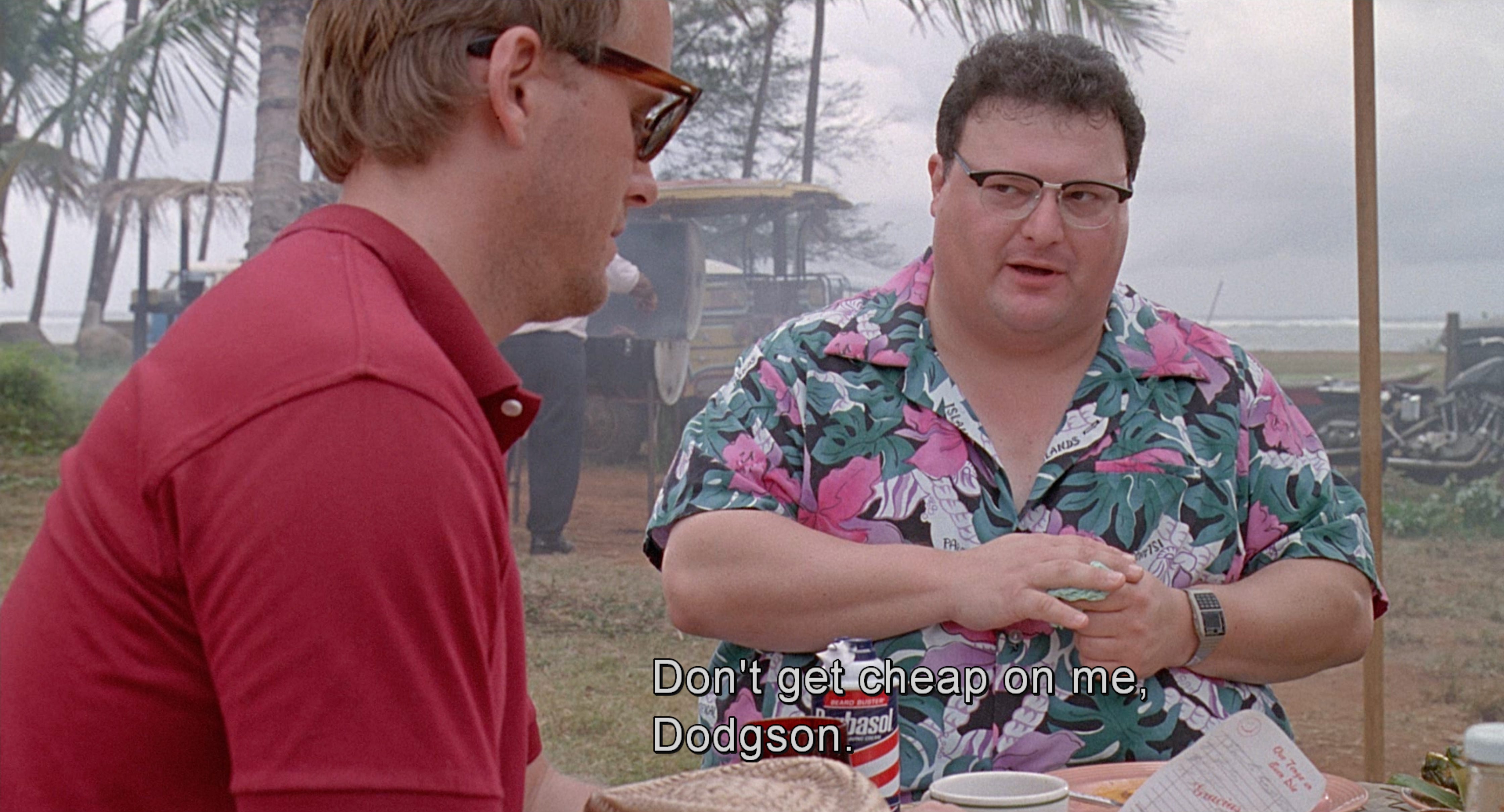
Or zap me off an electric fence.
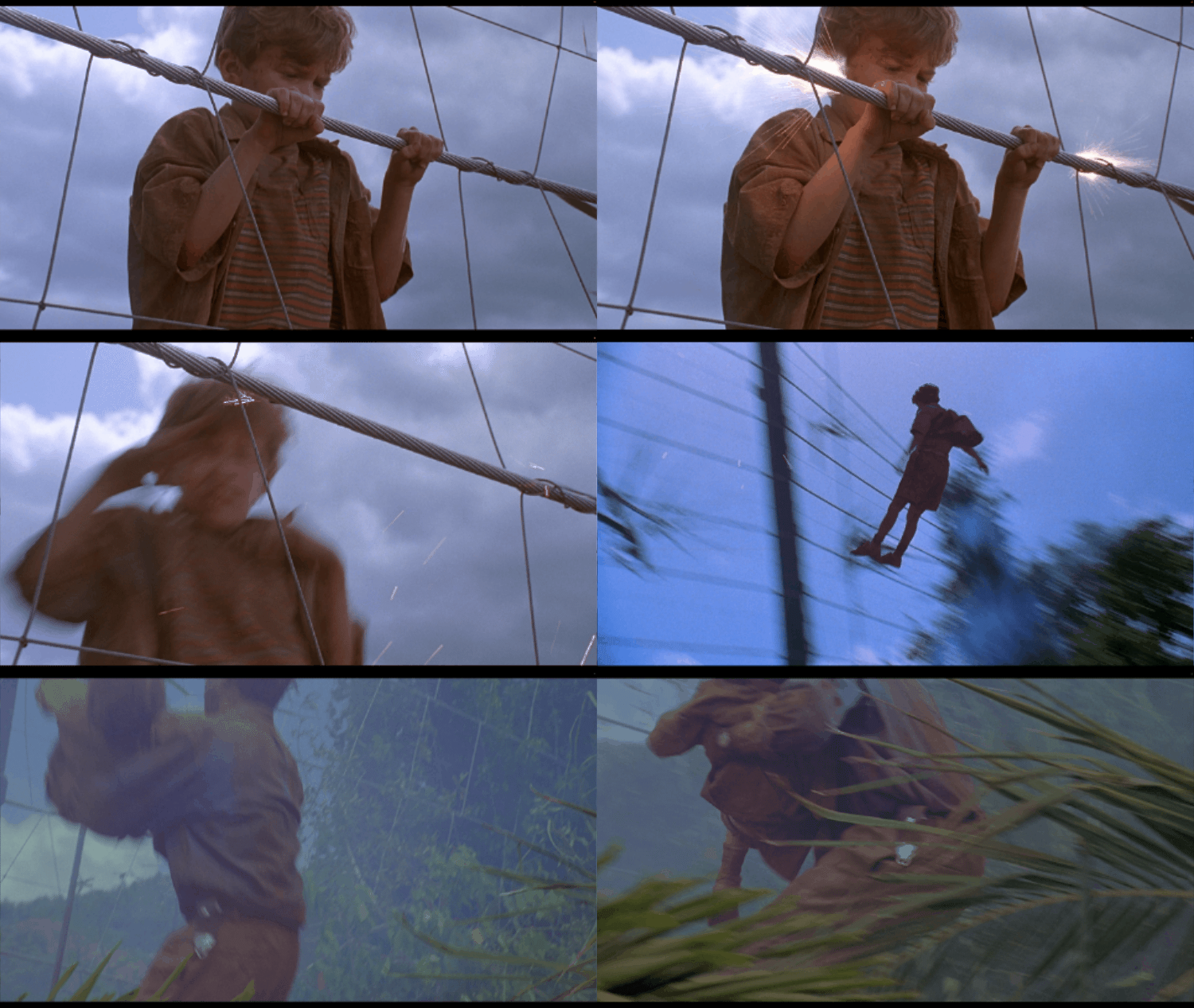
I meet a lot of John Williams fans who first got turned on to him during the Star Wars / Superman / Raiders years. As I’ve recounted many, many times, I too was watching those movies in the 1980s, but as a child without the cognizance of there being a man behind the music. It was only in 1994, in my cousin’s van in Orlando, when I had the eureka moment of learning who John Williams was and what he did.
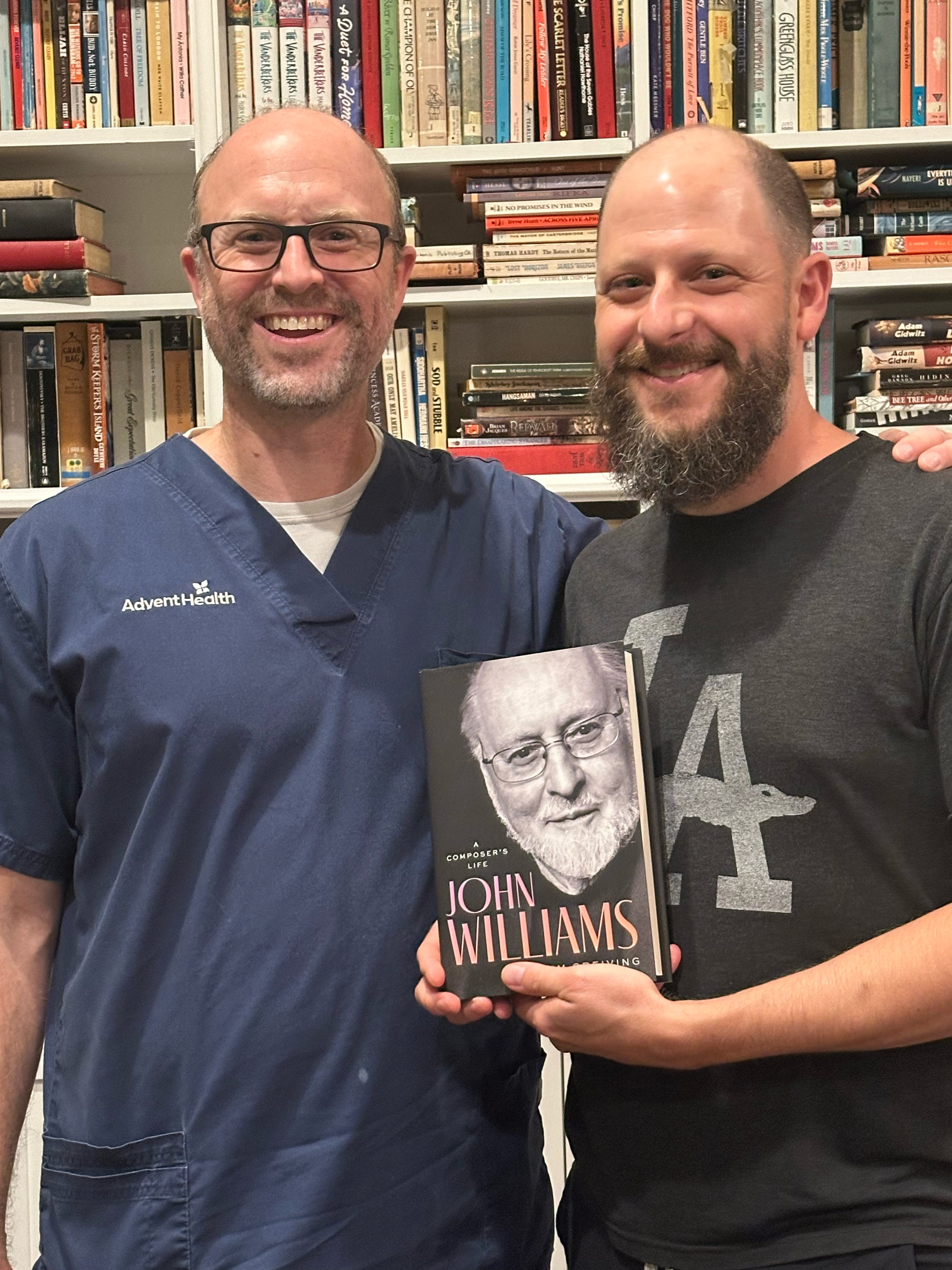
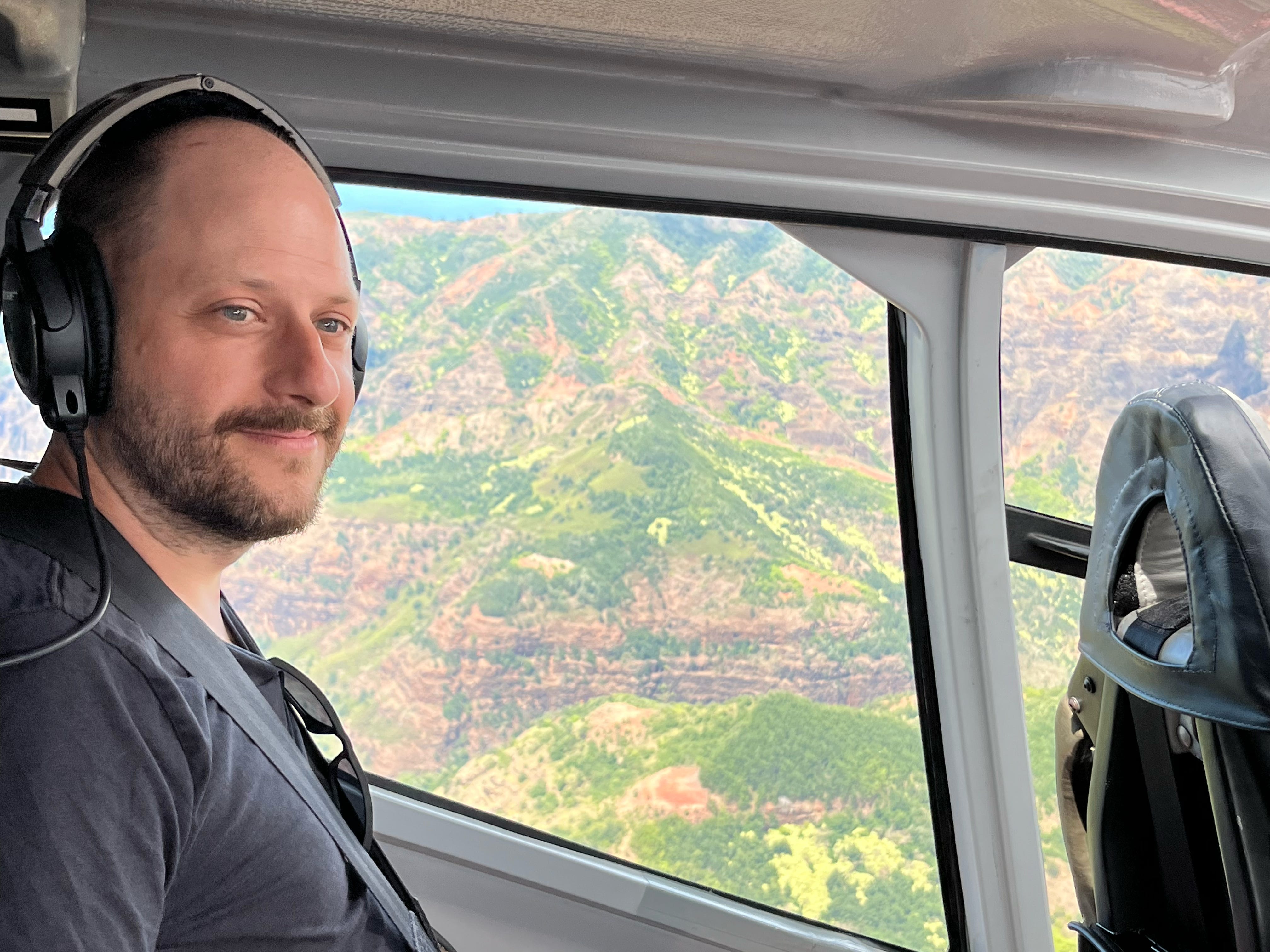
My lifelong love of Jurassic Park has led to some fun adventures. I have interviewed Sam Neill, Laura Dern, and Jeff Goldblum. I produced an NPR story on the theme and had Goldblum sing me his made-up lyrics to it. I wrote program notes for the Royal Albert Hall when the score was performed live to picture there. And when my wife and I went to Kauai in 2023, you know we took a helicopter tour of some of the iconic filming locations…
But what is it that makes this Spielberg/Williams creation so great? It was a hugely pivotal movie in both Spielberg’s career and Hollywood at large—it marked the real dawn of CGI, and everything good (and SO much bad) that that new age ushered in. It’s also the last movie Spielberg made before he teamed up with Janusz Kamiński, and every film he made just looked different (and often, in my opinion, not as good) after Jurassic Park—which looks incredible (Dean Cundey, who also shot Hook, was the director of photography). And while it was the first explosion of digital animation in Spielberg’s work, it’s also chock-full of incredible practical effects and creatures—giant animatronic puppets, completely real locations and amazing sets, textured production design. It still has a foot in the world of reality and handmade magic that Spielberg had been operating in for the first 20 years of his career.
It is, at root, just a rock solid story, with a lovable (or lovably hatable) band of characters. I love the collegial Alan Grant / Ellie Satler relationship, the slightly sleazy but utterly charming Ian Malcolm, and the gravitas (and fun) that Richard Attenborough brought to the party. (Apropos of nothing, but a year after he played John Hammond, Attenborough directed one of my favorite films of all time: Shadowlands.) To say nothing of Wayne Knight, Samuel Jackson, Joseph Mazzello (also in Shadowlands!), and Ariana Richards—a perfect cast.
And it is a really fun ride! Spielberg flexed his horror muscles in one spooky set piece after another, from the mysteriously freaky opening with the raptor attack, to the many rainy nighttime stalkings, to the haunted industrial basements and kitchens. Mixed into the horror are fantastic helicopter rides and time-bomb car chases and electric fence scalings and people running for their lives. There isn’t a dull moment in the entire 127 minutes.
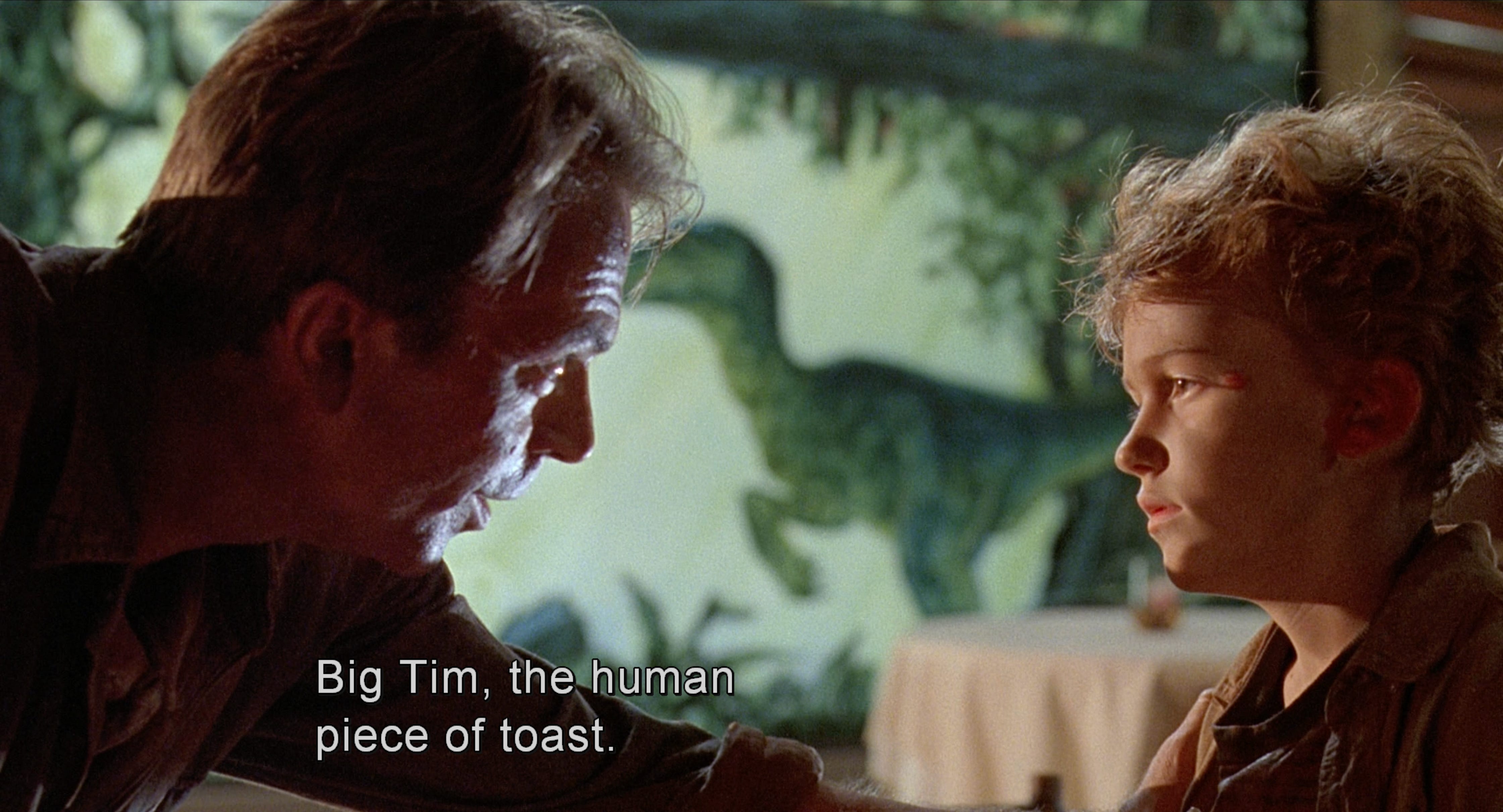
The character moments woven in—the playful banter, the sweet development of a paternal relationship between Grant and the kids, the teaming-up of Ellie and Muldoon, Malcolm’s wisecracks (“Remind me to thank John for a lovely weekend”)—are a perfect balance to the terror and the thrills. We care deeply about these people… and we’re also giddy to see Dennis Nedry eat it.
And, it has so many quotable lines.
I still can’t believe how many indelible melodies there are packed into this one score. This was only two years after John scored Hook, which already felt like it was packed with all of the great melodies of a single composer’s entire career. In Jurassic Park there’s the main anthem, the hymnal theme, but there’s also bespoke themes for the sick triceratops, Hammond’s memories of Petticoat Lane, and the dinosaur motto that opens the film and gives a lot of the action cues their muscle. And these are not mere throwaway secondary tunes: “Ailing Triceratops” would be among the most beautiful things any other composer would have written in their lifetime.
What do all of these character grace notes and gorgeous one-use melodies add up to? Was John Williams forcing beauty and majesty onto a silly horror show? Not at all: the performances, the story, and Spielberg’s vaulted cathedral image-making had ample space for, and soaked up, this symphony of splendor.
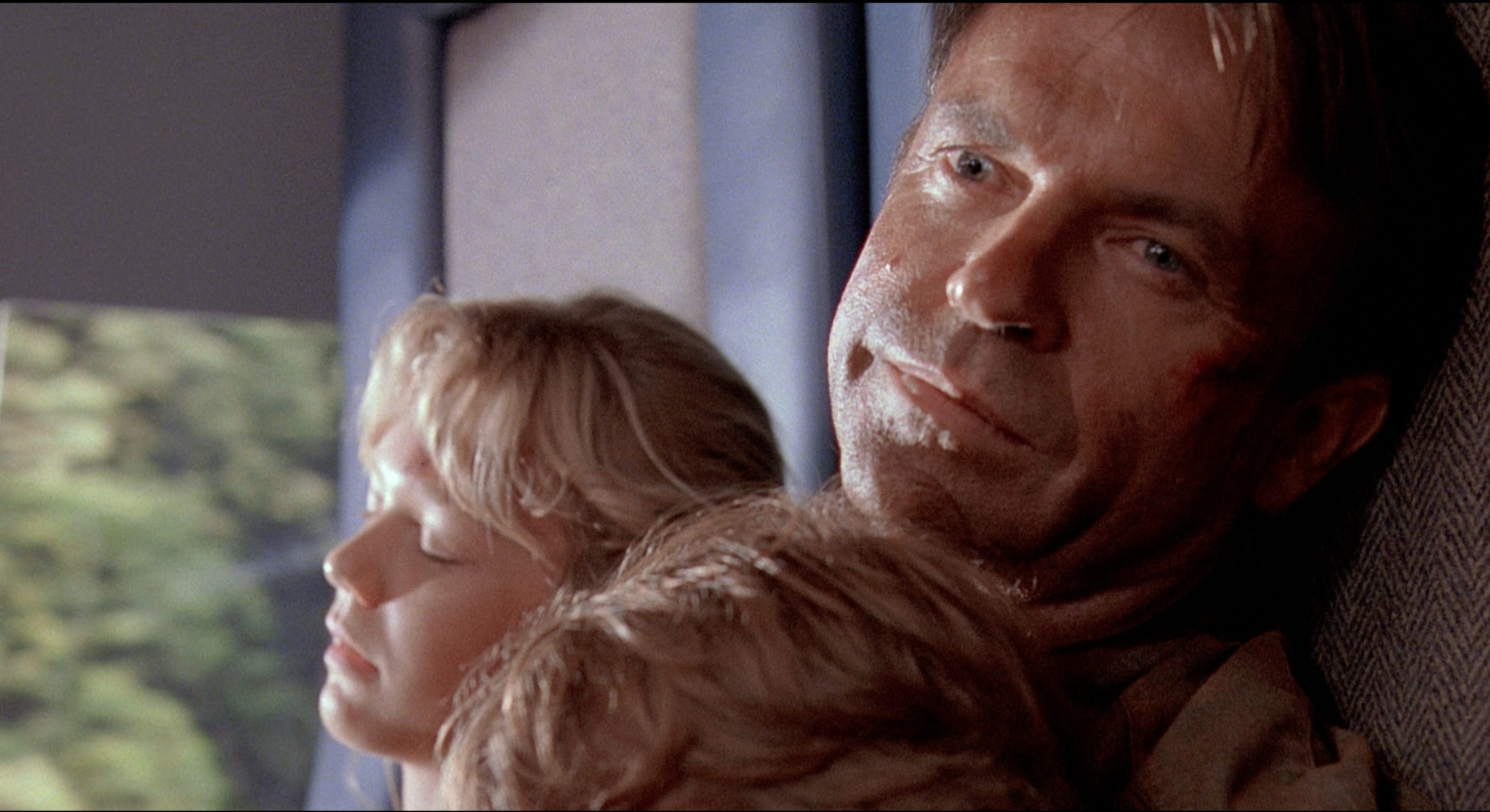
I think these moments and melodies are why Jurassic Park is more than just a fun-scary thrill ride. Every scene is a jewel, with something memorable or wonderful said by a character or played on the soundtrack, all adding up to a work that is unforgettable. That potentially disposable scene with the triceratops is, instead, cinematically immortal because a) it’s a fantastic practical creature, b) the look of childlike glee on Sam Neill’s face and the tears in Laura Dern’s eyes, and c) the melancholic, melodic beauty of John’s theme. John Williams imbues everything and everyone in this film (like he does in almost every film) with such nobility, such dearness. He attends everyone—even a sick dinosaur—with care. And we in turn care, and care deeply.
Another of my favorite moments is this delicate celeste lullaby that leads in to a tender statement of the main hymn. This is a classic Spielberg humanity moment—a grace note in the midst of all the action—and even the way it bleeds into a camera panning over the park merchandise has a melancholy, intimate effect. (John is such a genius at emotionally gluing scenes together like this.) A man who didn’t want kids before this trip suddenly finds himself acting as a protective father, and a man who wanted to create something magical for people is lamenting the pain he’s caused—all made holy by the Jurassic Park hymn.
But it’s the religioso factor that pushes this movie into the halls of all-time greatness. (It always is with me 😎) Who, besides John Williams, would watch a rough cut of a popcorn dino disaster pic and think: church music. Sure, the famous moment where Alan and Ellie see resurrected behemoths for the first time is one that obviously called for “awe and wonder.” But a stately, liturgico hymn for orchestra and choir? And what’s amazing about that theme, and that moment in the film, is that it’s not just a hymn of reverence—it also captures a sense of fun elation, of overwhelming joy. That’s why people literally walk down the aisle to it!
If John Williams had only ever scored Jurassic Park and written these themes, he would still be one of the greatest composers of all time. Gustavo Dudamel compared this score to Beethoven’s Pastoral Symphony; it’s that magnificent.
Nothing Spielberg/Williams made after Jurassic Park ever really captured the same salty-sweet trail mix of fun, horror, thrills, and sublime awe.1 Which isn’t to say it’s their last great film—by no means. It’s just the last of a kind.
And it was my initiation.
I would also argue that none of the Jurassic sequels justified their existence, and most of them are truly awful.
This was such a fun movie to see in the theater. It really surprised me. At the time, I thought of Spielberg as being in his grandfather phase where everything was just sweet and this film was unexpectedly terrifying like I'd imagine Jaws had been to those audiences though now tame for us who never remember a time before it. It's not a deep film, though is deep for a popcorn film.
I think you got it all in terms of the excellence of the score (I personally would place it below Jaws, but when you're talking gradations of genius, there is no bad placement....). I remember hearing the score on CD before seeing the movie, and expecting a scary, Jaws-type theme I was truly taken aback by hearing a theme of joy and wonderment - I mean, what the heck?? Wasn't this going to be a scary movie? I loved the music, but didn't understand at all how it would fit in with the visuals. Of course, seeing it in a theatre I again learned that in Williams/Spielberg I should trust - that first scene with them seeing the Brachiosaurus was (and is), one the most incredible movie/music moment I'd ever encountered - I got literal chills in the theatre, and it still gives me chills every time I see it, to this day (and as it turns out, the scary moments were in there just fine, thank you very much....). I will admit I love the score for The Lost World too - it's like Jaws 2 in that Williams came up with a fantastic, tonally different score for a mediocre (at best) sequel. In particular I find "The Hunt" track to be one of his hidden all time gems of Williams action music - left out of the movie itself, but a propulsive banger of a track that always gets the blood pumping. Last note: the score for Jurassic Park is so strong that talented, Oscar winning composers like Michael Giachinno and Alexandre Desplat can bring their A-games to Jurassic sequels...and for me, the only moments that resonate are the quotes of William's themes. You just can't compete with it, trying is a fool's errand. On to the top three!!