

Disclosure Day and Finale
Thoughts on the 30th Spielberg/Williams collaboration... and on saying goodbye

[SPOILERS GALORE]
I’m glad Disclosure Day exists. A new Steven Spielberg film is always going to be cause for celebration and gratitude for me, and especially a new Spielberg film with a new John Williams score. I’ve said it many times before, but to receive another of their collaborations anymore is a miracle.
And the best parts of John’s new score, I think, are somewhere between scrumptious and sublime. The last hour or so of the film is a showstopping showcase for John to crack open his musical heart and let it bleed, starting with a memory trip in a recreated childhood home and culminating in an impassioned adagio chorale over the end credits. There are notes of spirituality and celestial wonder and aching emotion in this score that stand tall next to his best work of the 21st century.
This film itself is not a backdoor sequel to Close Encounters or E.T., as some people speculated, but it is absolutely in conversation with those movies. Daniel (Josh O’Connor’s character) and Margaret (Emily Blunt) are like a new Roy and Gillian, on a frantic, daring chase for answers from the skies while dodging authority figures, trying to figure out these strange visions in their heads. They are also like grownup versions of Barry, abducted in mystery but not menace when they were children. (There’s even a blink-and-you’ll-miss-it shot of Devils Tower in the deluge of disclosure footage.)
And like E.T. and Elliott, the superpower bestowed on Margaret by the aliens is the ability to intensely empathize with other people—to feel their feelings. Spielberg’s whole life project—of loving the stranger, of redemptive humanism, of complicating the binaries that divide us and trying to understand our “enemy’s” point of view—becomes overt polemic in Disclosure Day. Characters talk about the vital importance of belief, about faith in God, and about the essential act of empathy. It’s not subtle!
Perhaps that’s one of the reasons I find the movie hard to wholly embrace. It speaks all the quiet parts that I love in Spielberg’s earlier works out loud, and somewhat crudely at that. I’m reminded of Christopher McQuarrie’s comment about Close Encounters being Spielberg’s least deliberately profound movie, and I can’t help but contrast that with the almost sweaty deliberateness of profundity in Disclosure Day. It often feels like a lengthy commencement speech disguised as an alien movie.
I like the idea of Margaret (a TV meteorologist) inhabiting the heartspace of various characters and forecasting their emotional weather, but the execution sometimes feels too heavy-handed—especially when she visually becomes somebody’s grandfather or little sister. Still, Blunt is the absolute best thing about this movie. Her performance is so individuated and three-dimensional; she toggles from breezy and casually funny, to awed religious visions, to speaking multiple languages, to hyperventilating with emotion or panic, to resolute calm. I love every choice she makes, and I think this is the best performance of her career.
She’s so good, unfortunately, that she makes everyone else feel kind of like a wet sandwich. I find O’Connor’s character a complete bore—a dry, mopey plot expositor without a sense of humor. Eve Hewson struggles mightily to give her character (Jane) intensity, but I simply don’t know who Jane is or care about her. Colin Firth actually feels miscast, or perhaps his character was just poorly conceived on the page, but I don’t enjoy his clammy performance here much at all. Colman Domingo does well with the scraps he’s given, but they are scraps; he’s mostly just a one-sided dialogue machine on a bluetooth earpiece.
Ultimately, I fear, this is a very thin pat of an idea scraped over too much bread. Not only that, but we’ve seen a thousand versions of this story before. What if aliens really did look like little grey men with giant eyes and made crop circles and actually crashed here before and abducted people and the government was keeping it all a secret? The X Files went there over and over again, and countless other shows and movies have trod the same territory. Disclosure Day is playing with clichés, and so it feels stale with few fresh surprises.
The more unique kernel of empathy-is-everything is nice, and very Spielbergian, but that thesis is swamped inside a shaggy conspiracy thriller where the conspiracy is already in full view and the thrills are few and far between. Seeing this a second time, I found the opening hour quite tedious, with the exception of Blunt’s scenes—I wish the movie was almost exclusively about her—because Daniel is just sulking and monotonously talking about the plot and Scanlon is monotonously plotting and tracking his location.
“Diving” is another intriguing concept, and I like the visuals of Jane’s eye color changing as Scanlon invades her mind, and her fighting to resist his possession of her. But once I knew where all of that was going (on my second watch), I found those scenes completely lacking in suspense or magic—and, again, tedious. After seeing this movie, my wife said: “I never thought I’d get tired of Colin Firth,” and I knew exactly what she meant.
There’s finally a big jolt of energy when Daniel and Margaret meet up in Scanlon’s trailer and have their moment of spiritual communion, which prompts the first real bloom of beauty in John’s score—a mystical fantasia for piano and strings (“Believe” on the soundtrack). The energy is then ratcheted up to full-body frisson during the incredible train set piece—one of the best action scenes in a Spielberg film in a long time. And I am truly moved by its emotional aftermath, set in a train car filled with jangling pianos, when Margaret has a panic attack. There are, without question, some genuine highlights and Spielberg stunners in this movie…
They’re just rare. The big swings that the film takes, of Hugo having built a replica of Margaret’s old house (doing exactly what Spielberg did for himself with The Fabelmans and what the super-Meccas do for David in A.I.), are conceptually intriguing, but the payoff here rings as false as the CGI animals in the too-cutesy little girl’s bedroom. For some reason, I just can’t surrender to the sentiment in that sequence, and I can’t suspend my disbelief. The artifice, the phoniness, the Thomas Kinkade idyllic goo is just too thick.
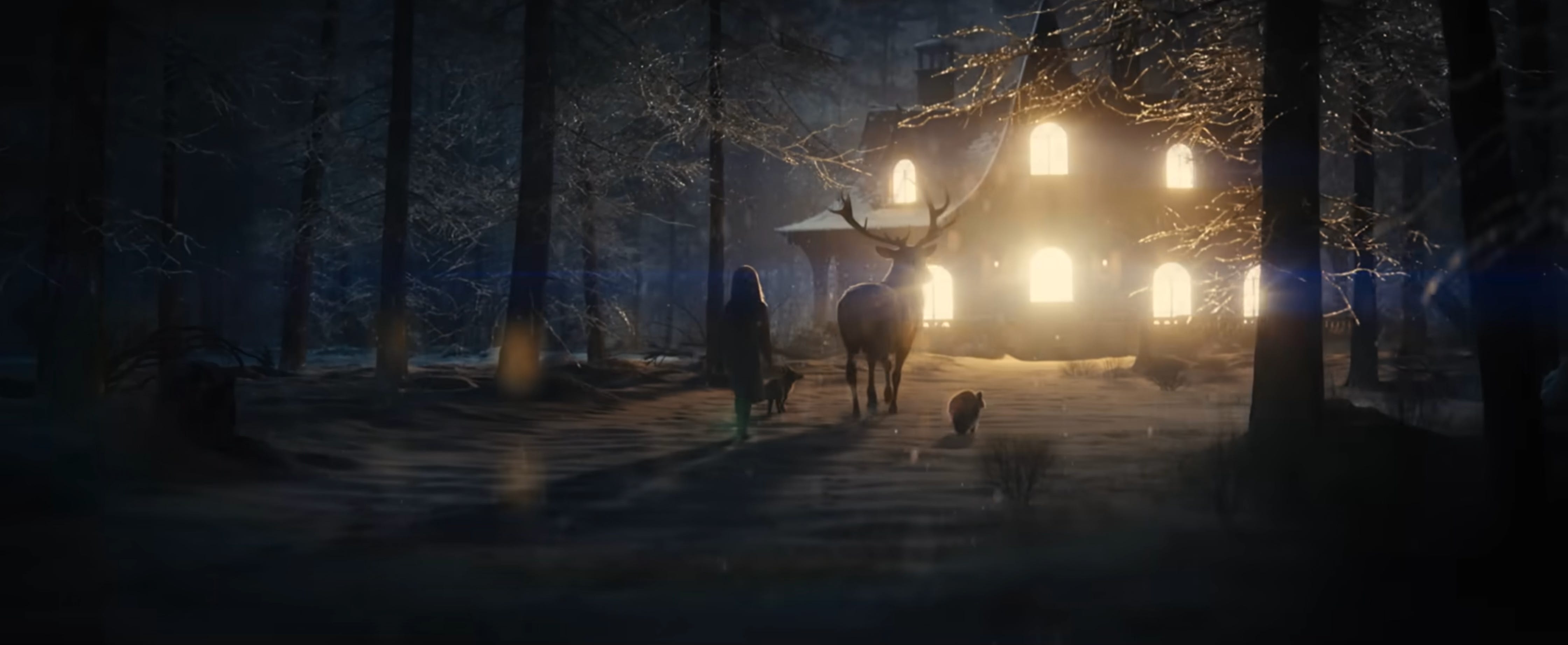
But as a vehicle for John Williams, our premier composer of religioso music for human connection and close encounters of various kinds, the film is a silver platter gift. The proper introduction of this score’s main theme, as Margaret walks through her old house and down the paths of her memory, commences a stunning musical journey. The melody—a halting, searching tune that gets passed from solo piano to French horn—shares some DNA with John’s melancholy theme for Archimedes in Indiana Jones and the Dial of Destiny… fittingly both about old memories and wanting to go back to the past. It’s warm, comforting, and lyrical, but decidedly open-ended and shaped like a question mark.
John has scored so many of Spielberg’s odysseys back into his own childhood; this one has the distinction of old age—a little weariness, yes, but also deep wisdom, even serenity.
He brings wordless choir in as Margaret retraces her long-buried memories out of her girlhood bedroom and through the snow toward a glowing cottage. This shimmering choral cue (“Celestial”) harkens into his past as far back as Family Plot and Close Encounters, but it also reminds me of A.I. and even John’s (as yet unreleased) piece for Yo-Yo Ma, Great Ocean Forests. There’s some aleatoric unease in this cue, befitting the slightly terrifying creatures observing and manipulating two young children, but it resolves into a childlike lullaby version of the main theme—as if reconciling all of the terror and the wonder in Spielberg’s canon into a quiet and restrained state of peace.
I enjoy the action and conspiratorial cues in the score—the more I listen, the more delightful details I’m discovering—but the standout material for me is far and away this more spiritual, emotional music. The music for the titular “Disclosure” adds subtle, heartbreaking pathos to what, on screen, doesn’t really work for me; I just don’t buy the entire world stopping in their tracks to watch (with utter faith) CNN broadcasting dubious digital snippets of footage of spaceships and sick aliens. But as he so often has, John provides the faith in this moment and the heartsick feeling that the characters are demonstrating.
When the last word was spoken (“Listen”) and John’s end credits cue of the same name kicked in, I sat in stunned, holy silence. I felt so much raw passion and emotion in this music; it’s the highlight of the entire score for me, and it is fascinatingly full of beautiful anguish, like John’s “Arlington” adagio in JFK or his music for Angela’s Ashes. Why? Why was that the mood he wanted to leave the audience with after all of humanity learns we’re not alone in the universe. It’s a reprise of the theme attached to Margaret (and Daniel’s) memory of childhood abduction—but it’s equally about memory. John’s memory, and ours.
One of the main themes of his life and philosophy, as I explore in my book, is that we all share the same collective memory, which is the main reason he believes music moves us the way it does. It’s almost like, with “Listen,” he wrote the theme for his own life.
There is a feeling of farewell to this piece, and to the score as a whole. Maybe this is the last score John will ever write, the last Spielberg/Williams collaboration. It’s impossible to know, and John has continued to (delightfully) thwart our expectations time after time. We know it’s not the last music he’ll write; a few weeks ago the LA Phil premiered a new fanfare, Bravo Gustavo!, which he wrote for Gustavo Dudamel after he finished scoring Disclosure Day—a miniature showcase for trumpet quartet and orchestra that swings from elbowed dissonance to exuberantly youthful Latin dance. And, I hear exciting rumors of other compositions.
But if this is his swan song in film scoring? It doesn’t get much more profoundly beautiful. I’m so glad Disclosure Day exists.
Speaking of farewells…
I have spent a lot of time, breath, words, and energy on my love for Sirs Steven Spielberg and John Williams. A book, a Substack, a limited podcast, and countless articles, lectures, interviews, and casual conversations, all in service of my love for these two men who I’ve openly claimed as my two favorite artists of all time.
And I’m not nearly tired of this oceanic topic, I haven’t come close to exhausting my well of love and observations and new discoveries of their canon. I imagine I’ll be watching and listening and loving their work for the rest of my adventure on earth.
But there comes a time when an idée fixe needs to take a rest from its endless spinning. I’ve devoted the last six years almost exclusively to studying and writing and talking about John Williams, and while it has been the greatest honor and adventure of my life, I feel it’s time I need to leave Never-Neverland… at least for a while.
I remain forever grateful for the extremely magical wish that came true for me, grateful for all the beautiful quality time I got to spend with John, grateful for the way that he and his family and colleagues have embraced my book. I am, in so, so many ways, the luckiest John Williams fan on earth.
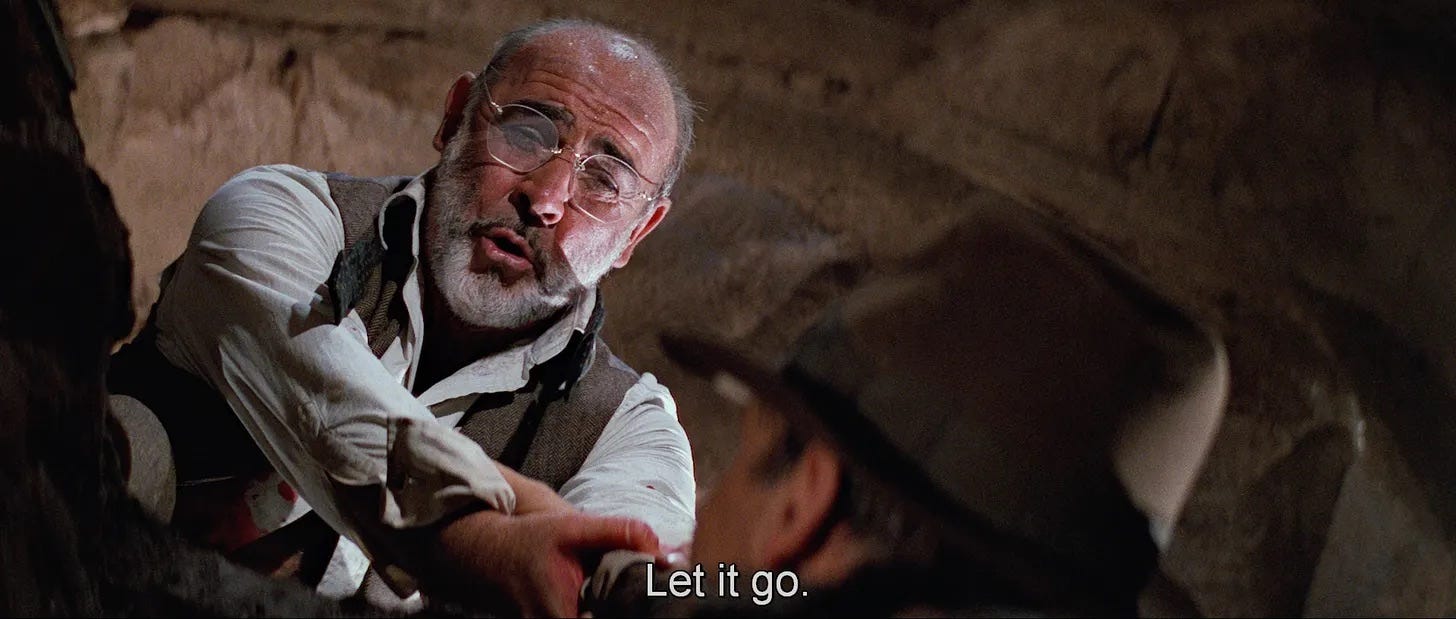
So what does all this mean for Behind the Moon?
It means that, as of today, I’m taking a prolonged pause. Truth be told, I have exhausted what I feel I can share in a weekly essay on the topic of John Williams; and while I could pivot more into my “Alchemy” series about film music as a whole, I’m also, well, exhausted. After 14 consecutive months of posting here on a weekly basis, and after 10 straight weeks of producing a time-consuming podcast series… I’m ready for a break.
The entire archive—all of my behind-the-scenes essays about the book, insights into the research process, posts about various and sundry topics related to John Williams, recorded town halls and interviews, exclusive video and audio content, and the entire Why We Love Spielberg/Williams series—will remain available to those with paid subscriptions, which I hope is a valuable, evergreen resource to anyone who loves John Williams.
I will continue to pop back in here with updates or surprise posts, and I may do considerably more than that once I’ve had a chance to regroup and think about the potential future of this whole project. So please: stay tuned!
But for now, I just want to thank all of my 700+ subscribers for going on this journey with me, for your kind and thoughtful comments, your sharing posts with others, your making me feel less alone in a very solitary vocation, and just for being part of this congregation of John Williams adorers. It’s been a blast.
Don’t hesitate to reach out to me: tim at timgreiving dot com. I’ll still be right here.
Remind me to thank John for a lovely weekend!
I’ve just finally got to see the movie after a whole host of minor disruptions at home and thus I have been able to lift my own media embargo (it’s been tough!) and catch up. I have to say, I enjoyed the movie but it’s definitely good over great. I’d agree with Tim in the main on performances in particular - although I thought the Hugo “narrator” character did add some gravity in a way. I have to say it’s a beautiful movie at times, if always a little strange and for me a little mixed in message / missing some momentum at times. As for the score, well, some stunning omissions as always from the soundtrack release and just a gem, a total gem and many of the tracks I didn’t enjoy on listen one are now my favourites meaning it’s a great one ! To you Tim, enjoy the rest - thank you for your amazing work and hopefully you’ll not look away first !
I can't read the majority of this article yet as I haven't been able to get out to see Disclosure Day (next week, I hope), but I read the end/coda. I'm actually glad you're not going to force yourself to find something to write about just to keep it going - that would diminish the work you've gifted us with until now. You've given us your best, so we won't settle for less....even if that means fewer posts, perhaps far apart. That said, I'll eagerly read anything you choose to share, and will anticipate your future projects (and hey, I still have your Disclosure Day article to read next week once I've seen it!) Best wishes, and thanks for the incredible adventure on Earth as we travelled through mines and shark infested waters, skimmed along the waters of Neverland, and found ourselves in Jurassic Park. You always kept your whip handy, you climbed Devil's Tower, and brought us places where dreams come true. It's been a blast!